Posted by Andrew Leigh · November 27, 2019 9:01 AM
E&OE TRANSCRIPT
DOORSTOP
PARLIAMENT HOUSE, CANBERRA
WEDNESDAY, 27 NOVEMBER2019
SUBJECTS: Labor to recall Westpac for questioning; wages growth stalling under the Coalition; interest rates; national security; Angus Taylor.
ANDREW LEIGH, SHADOW ASSISTANT MINISTER FOR TREASURY AND CHARITIES: Good morning. My name is Andrew Leigh, the Shadow Assistant Minister for Treasury and the Deputy Chair of the House of Representatives Economics Committee. We’ve seen last week from Australia's oldest bank one of Australia's worst money laundering scandals. Westpac reported 23 million breaches of money laundering laws, an egregious blight on the financial sector.
It was Labor that called for a royal commission into the financial services, and it's Labor that's today calling for Westpac to front the House of Representatives Economics Committee. We can't wait for the next hearings next year when Westpac is scheduled to come before us. Westpac should come before the House Economics Committee at the earliest opportunity. This scandal has already seen Westpac’s CEO and Chair step down, but it's important that we look at this from an institutional standpoint. It's important we get to the bottom of what Westpac did wrong, how the child exploitation financing occurred, how the money moved, and how this was allowed to recur 23 million times - almost one breach for every Australian.
Posted by Andrew Leigh · November 26, 2019 5:24 PM
HOUSE OF REPRESENTATIVES, 26 NOVEMBER 2019
The Australian Research Council plays a crucial role in allocating research funding in Australia. As a former professor at the Australian National University, I was the successful recipient of two Linkage Program grants and two Discovery Project grants, and I put many hours into reviewing proposals put forward for Australian Research Council funding. I can attest to the House that this is a common practice for academics. Contestable research funding is an important part of our system, and Australian researchers rely on the independent scrutiny of the Australian Research Council.
Researchers recognise that the peer review process is extraordinarily rigorous and give it greater respect than other methods of handing out research funding, such as the more ad hoc approach employed by the Medical Research Future Fund as well as other funding systems which have more ministerial meddling in them.
E&OE TRANSCRIPT RADIO INTERVIEW ABC RADIO SYDNEY TUESDAY, 26 NOVEMBER 2019
SUBJECTS: Innovation + Equality; Westpac.
WENDY HARMER: We have a text here saying ‘more good news stories please’. Maybe we've got one, maybe we can put Andrew Leigh under the category of a good news story. He's a Federal Labor MP, co-author of a new book, Innovation + Equality: how to create a future that is more Star Trek than Terminator.
ROBBIE BUCK: Well we hope it's a good news story, but is it going to be a good news story? That's the big question. Good morning, Andrew.
ANDREW LEIGH, SHADOW ASSISTANT MINISTER FOR TREASURY AND CHARITIES: Morning, Robbie. I think it's a good news story, but I'm not sure it's as good news as kids playing in gardens.
Posted by Andrew Leigh · November 26, 2019 10:30 AM
E&OE TRANSCRIPT RADIO INTERVIEW 5AA ADELAIDE MONDAY, 25 NOVEMBER 2019
SUBJECTS: Innovation + Equality; 2019 election; disconnected communities; China; the need for a more ethnically diverse Parliament.
JEREMY CORDEAUX: I've got Andrew Leigh on the line. He's a politician, he's with the Labor Party. He's the Deputy Chair of the Standing Committee on Economics, which sounds awfully dry but having spoken to him before, I can tell you he's not awfully dry - he's a lot of fun. Andrew, how are you?
ANDREW LEIGH, SHADOW ASSISTANT MINISTER FOR TREASURY AND CHARITIES: Terrifically well, Jeremy. The better for chatting with you.
CORDEAUX: Happy Christmas.
LEIGH: And to you. You got big plans for the season?
CORDEAUX: No. I think probably, I think we go on holidays two weeks from today, something like that. No, I'm just going to fall over the line and just go home and play in the garden.
LEIGH: That sounds like the rest of Australia.
CORDEAUX: [laughter] Well, the worst thing is to make plans because the moment you start making plans, they won't happen. Everything will change right there in front of you. It's not it's not worth it.
LEIGH: There is some great economic research that suggests that much of the pleasure of holidays comes not from having them, but from anticipating them. So our family always tries to plan our holidays as far in advance as we can, so we can have that anticipation effect.
CORDEAUX: But Andrew, isn't that about everything in life? Isn't the anticipation, the pre savouring of something, far more interesting than the actual meal?
Posted by Andrew Leigh · November 25, 2019 3:50 PM
HOUSE OF REPRESENTATIVES, 25 NOVEMBER 2019
I move:
That this House:
(1) recognises that:
(a) Australia's incarceration rate has now risen to 0.22 percent, the highest level since Federation;
(b) rates of homicide, robbery, car theft and assaults have fallen considerably since the mid-1980s, while the imprisonment rate has more than doubled;
(c) the direct cost of prisons is almost $5 billion per year; and
(d) there is a significant indirect cost of prisons, including the impact on the 77,000 children who have an incarcerated parent, adverse effects on the physical and mental wellbeing of inmates, and high rates of homelessness and joblessness among ex-prisoners;
Posted by Andrew Leigh · November 25, 2019 1:02 PM
MORE STAR TREK THAN TERMINATOR?
Inside Story, 25 November 2019
The most significant consumer innovation of the last decade was announced on 9 January 2007. Despite uneven health, Apple chief executive Steve Jobs took to the stage at the Macworld Conference in San Francisco and unveiled the iPhone. Ten years later, a billion of them had been sold. Today, many think touchscreen smartphones are as necessary as underwear and more important than socks. Yet when Jobs launched his revolutionary phone, many believed it would fail. His counterpart at Microsoft, Steve Ballmer, laughed at the device, calling it “a not very good email machine.”
The critics were wrong, and wrong in a major way. As industry insiders, they all paid the price for their poor predictions. Their products would all exit the industry, replaced by the new Apple, of course, but also by Samsung and Huawei. What turns out to be a successful innovation might not seem that way at first. There is a reason for that: innovation is new to the world. If it was obvious, someone would have done it.
Posted by Andrew Leigh · November 25, 2019 9:57 AM
E&OE TRANSCRIPT TV INTERVIEW SKY NEWS FIRST EDITION MONDAY, 25 NOVEMBER 2019
SUBJECT: China.
LAURA JAYES: Joining me now is Labor MP Andrew Leigh. He joins us live from Canberra. Did you see this last night? How concerned are you?
ANDREW LEIGH, SHADOW ASSISTANT MINISTER FOR TREASURY AND CHARITIES: Laura, very concerned. I think both the stories you're talking about, concerning Mr Wang and Mr Zhao, raise issues of the first order importance for Australia. It's not unusual for Australia to provide asylum status to people who say that they might be harmed if they go back home. Chen Yonglin was the Chinese official granted asylum a number of years back. Before that of course you think of Vladimir Petrov. What's most important is that Mr Wang’s safety is looked after in the interim, while the government carefully works through the details of his application.
JAYES: Do you think the government as well though needs to consider concerns like copycat approaches by lower level operatives, and also the backlash that we could see from China both economically and politically?
LEIGH: There's no scenario in which Australia's relationship with China isn't of first order importance to Australia. It's important that we maintain those strong economic ties, which improve prosperity in both countries. But at the same time, we need to recognise we have different political systems, different sets of values when it comes to issues around democracy and human rights. We should never hold back from staying true to those values.
Posted by Andrew Leigh · November 24, 2019 1:17 PM
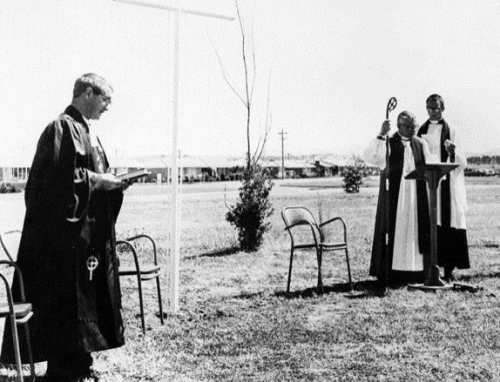
‘Radical’ tale of the shared church
At the dedication of the Hackett church in 1967… from left, Don Erickson, Kenneth Clements and Colin Rush.
Published in City News, 27 March 2019
In the mid-1960s, clergymen Don Erickson and Colin Rush were each in charge of building a new Canberra church. The plan was for Erickson to build a Presbyterian church and Rush an Anglican church.
The Federal government had given them separate parcels of land and both had engaged an architect to prepare plans. Then Erickson and Rush, who had done their theological training at the same college, discovered that they had hired the same architect, who had given them similar designs, both to be built in the same suburb: Hackett.
Posted by Andrew Leigh · November 23, 2019 11:37 AM
Review of Alain de Botton, The School of Life: An Emotional Education
Sydney Morning Herald, 23 November 2019
In 1901, 98 percent of Australians told Census-takers that they adhered to a religion. For the vast majority, religion was where we got our notions of what it was to live a ‘good life’. Today, nearly one-third of Australians reports having no religion: seeking wisdom not from the pulpit, but from secular sages.
If there was a high priest of the unbelievers, it would be Swiss-born philosopher Alain de Botton.
Since writing Essays in Love at the age of 23, he has published a dozen books including How Proust Can Change Your Life, The Art of Travel, The Architecture of Happiness, Religion for Atheists, How to Think More About Sex and The News: A User's Manual.
Posted by Andrew Leigh · November 22, 2019 1:35 PM
E&OE TRANSCRIPT TELEVISION INTERVIEW SKY NEWS AM AGENDA FRIDAY, 22 NOVEMBER 2019
SUBJECTS: Anthony Albanese’s economic vision statement; the economy; Westpac.
ANNELISE NIELSEN: Now for a check in on what's happening in politics we're joined live by Andrew Leigh from the Labor Party. Andrew thank you for your time.
ANDREW LEIGH, SHADOW ASSISTANT MINISTER FOR TREASURY AND CHARITIES: Absolute pleasure.