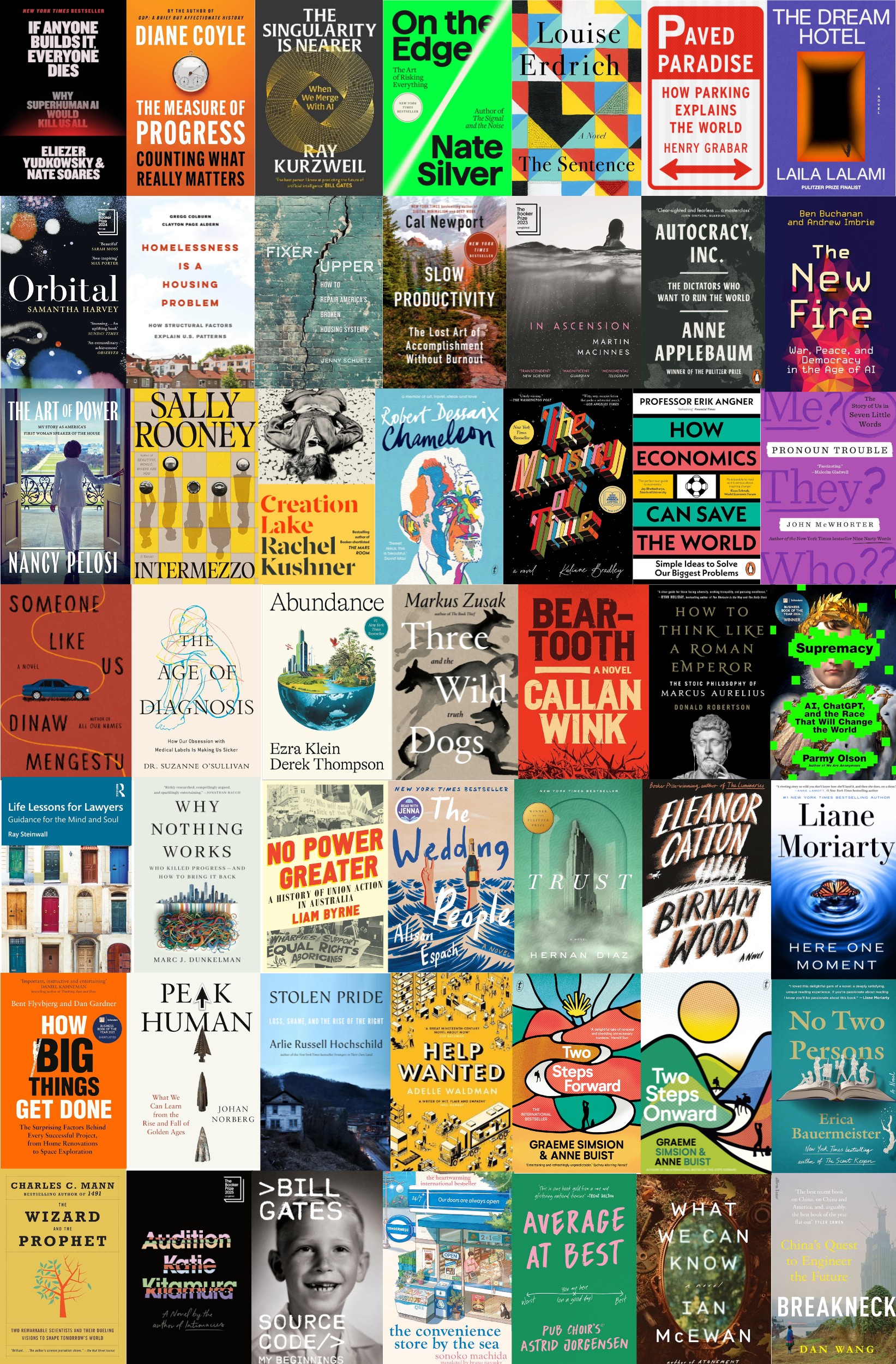
Here’s my annual round-up of books that made the biggest impression on me this year. Some are fresh off the press, others have been waiting patiently on the shelves. The 53 books are organised by theme, and within each group I’ve listed them in the rough order of how much they resonated with me. I’d welcome your own recommendations.
Stories to Escape Into
Erica Bauermeister, No Two Persons – The title comes from the saying that ‘no two persons ever read the same book’. In this delightful book, we see how nine different readers are affected by reading the same novel.
Sally Rooney, Intermezzo – ‘Like a stage fight where it turns out the knives are real’. A delightful exploration of romantic entanglements, family dynamics, and chess, set in modern-day Ireland.
Kaliane Bradley, The Ministry of Time – Billed as 'speculative fiction': a tale of time travel set in the near future that harks back to the Victorian era. Quirky, sexy and pacy.
Katie Kitamura, Audition – The journey begins when an older actor meets a young man who claims to be her son. A wonderfully weird novel about families, memory and how both can fail us.
Laila Lalami, The Dream Hotel – Set in the near future, a woman is imprisoned for a crime she hasn’t yet committed. Creepy, prescient, and impossible to check out of.
Rachel Kushner, Creation Lake – Follows a modern-day Mata Hari infiltrating a leftist group in France. The writing includes lines like ‘a talent for washing up on the shores of chaos’.
Louise Erdrich, The Sentence – Tookie, a Native American woman, works in an independent bookstore that's haunted by the ghost of a former customer. The novel has touches of magic realism, as it explores themes of family dysfunction and rebuilding.
Martin MacInnes, In Ascension – This novel plays at the boundary between reality and sci-fi. ‘In Ascension’ is set in the depths of the ocean and the far reaches of outer space, beautifully exploring what it would mean if humanity discovered we are not alone in the universe.
Dinaw Mengestu, Someone Like Us - Migrant stories are endlessly engaging. This novel follows Ethiopian-born taxi drivers striving to make a living and find their niche. Favourite quote: ‘You're like a donut. There's a hole in the middle, where something solid should be.’
Ian McEwan, What We Can Know – A century in the future, with much of the world covered by rising seas, scholars search for a lost poem.
Samantha Harvey, Orbital – There's plenty of divisiveness around. For an antidote, try Samantha Harvey's beautiful (and short) Booker prize winning novel, ‘Orbital’.
Stories of People and Places
Callan Wink, Bear-Tooth – Like Richard Flanagan in ‘Death of a River Guide’, Montana fly-fishing guide Callan Wink has written a capacious story about bears, brothers and Yellowstone. Loved it.
Eleanor Catton, Birnam Wood – Eco-warriors, billionaire power, drones and online surveillance dominate the plot of this novel, but what I loved most were its depictions of New Zealanders and their rugged bushland.
Sonoki Machida, The Convenience Store by the Sea – Overlapping tales of friendship, knitted together by a convenience store that sells too-perfect-to-be-real sweets, staffed by an impossibly handsome store manager.
Alison Espach, The Wedding People – A divorced literature professor goes to a beachside resort to end it all and finds herself in the midst of a complicated wedding. Breezy and engaging.
Liane Moriarty, Here One Moment – I went on a bit of a Liane Moriarty binge this year, starting with her latest, which asks whether the anticipation of death can help us live more fully. BYO memento mori.
Liane Moriarty, The Husband’s Secret – This book has a fabulous plot, involving family and school intrigues and a murder on Sydney's northside. If I had a quibble, it'd be that the conclusion wraps up a little too neatly.
Liane Moriarty, What Alice Forgot – How would you live your life if you suddenly became the person you were 10 years ago? A family-filled novel about memories, growth and loss.
Graeme Simsion and Anne Buist, Two Steps Forward – From tapas to toe blisters: life lessons on the Camino, told by two of Australia’s best storytellers.
Graeme Simsion and Anne Buist, Two Steps Onward – In the sequel to ‘Two Steps Forward’, Zoe, Martin and their companions trek the Chemin d’Assise from France to Rome. Plenty of walking, wine and middle-aged shenanigans.
Hernan Diaz, Trust – Centred around the 1929 share market crash, this novel unfurls slowly, but comes to a splendid crescendo. A story about the writing - and rewriting - of history.
Ideas for Living Well
Cal Newport, Slow Productivity – Cal Newport discusses how to replace the treadmill of ‘jittery busyness’ with breakthrough achievements that really matter.
Markus Zusak, Three Wild Dogs (and the truth) – A tail-wagging memoir of mischievous dogs and the way we love them. Listen to the audiobook, and you'll hear Markus's voice catch as he recounts the saddest bit. A gorgeous, gutsy tale.
Scott Galloway, Notes on Being a Man – Boys and young men are looking for guidance. If wise people step back, angry charlatans will take their place. Galloway is honest about his muck-ups, and distils his advice into bon mots such as ‘get out of the house’, and ‘spend more time sweating than watching other people sweat’.
Robert Dessaix, Chameleon – Musings on pleasure, art, sex, literature, infatuation, happiness, music, life, death and all the rest. Listen to a podcast of our ANU conversation.
Donald Roberston, How to Think Like a Roman Emperor – Stoicism is endlessly fascinating, and a neat feature of this book is that the author is a cognitive psychotherapist, so combines insights from both philosophy and psychology (e.g. the compatibility between Cognitive Behavioural Therapy and Stoicism).
Ray Steinwall, Life Lessons for Lawyers – Forget ‘Suits’: this 135-page gem from one of Australia’s top competition lawyers is about humility, mental health, and pro bono work. A wise, readable antidote to the dog-eat-dog myth of legal life.
Nate Silver, On the Edge – A book about rationalists versus the rest. I enjoyed his deep dive into poker (where I know very little) and his interviews with the likes of Sam Altman and Sam Bankman-Fried.
Lives Worth Knowing
Astrid Jorgensen, Average at Best - Pub Choir invites a roomful of people to sing in harmony, daring to be vulnerable in front of strangers. It's the spirit that Astrid brings to this splendid memoir, in turns funny, embarrassing and touching. My podcast interview with Astrid a few years back.
Bill Gates, Source Code – Bill Gates’ high school had better computing access than some universities of the era. To his credit, he recognises the role of luck - as well as hard work - in shaping his career and the computer revolution of the 1970s.
Nancy Pelosi, The Art of Power – Nancy Pelosi's autobiography covers her rise to become the First Woman Speaker of the US House, addressing the AIDS crisis, enacting healthcare reform, the attack on her husband, and the storming of the Capitol. A memorable read.
Charles Mann, The Wizard and the Prophet – The ‘Wizard’ is green revolution pioneer Norman Borlaug. The ‘Prophet’ is environmental activist William Vogt. This engaging book isn't just a double-biography; it also ranges widely over science policy, discussing everything from genetic engineering to energy.
Understanding the World
John McWhorter, Pronoun Trouble – From the author of ‘Nine Nasty Words’ (a history of swearing) comes a fascinating book on pronouns - how they’ve evolved, and how we use them. From the royal we to the singular they, it's a book for everyone who loves words.
Suzanne O’Sullivan, The Age of Diagnosis – I haven't read enough of the science, but the idea that a diagnosis can have downsides as well as upsides seems intuitively sensible. A fascinating and provocative read.
Johan Norbery, Peak Human – A wide-ranging look at what explains history's most successful societies. The answer? Openness to new ideas, investment in science, and optimism about the future.
Liam Byrne, No Power Greater – From the Wave Hill walk-off to the Patricks dispute, the Chinese Cabinetmakers Union to migrant outworkers, this lively history tells how Australian unions have shaped work, community and society.
Diane Coyle, The Measure of Progress – a leading economic historian explains what our economic statistics might miss – including capital, time and the digital economy. Wonkish, but good. My review in Inside Story.
Arlie Russell Hochschild, Stolen Pride – Through a series of interviews in Appalachia, one of America's top sociologists explores a psychological double-whammy: the US communities that have suffered the worst job losses tend to be places where people believe that effort, not luck, determines success.
Adelle Waldman, Help Wanted – If you liked the TV show ‘Superstore’, you'll enjoy this new novel, a vivid portrait of the people who keep retail running.
Erik Angner, How Economics Can Save the World – Perfect for econ-sceptics who don't know much about the discipline, this book distils many of the ideas from recent books by the likes of Emily Oster, Bryan Caplan and Ester Duflo. Angner's family move from the US to Sweden put lifestyle over salary: a reminder that economics is about maximising wellbeing, not money.
How Countries Tick
Dan Wang, Breakneck – From the one child policy to high speed rail, an insightful discussion of the strengths and weaknesses of a country run with an engineering mindset.
Sam Dalrymple, Shattered Lands: Five Partitions and the Making of Modern Asia – Less than a century ago, the people of modern-day India, Pakistan, Bangladesh, Nepal, Burma, Bhutan, Yemen, the UAE, Oman, Qatar, Bahrain and Kuwait were part of a single ‘Indian Empire’. Dalrymple tells the story of the five partitions that broke it apart. Crucially, it’s not just a diplomatic tale, but one with engrossing stories of the lives that were reshaped in the process.
Anne Applebaum, Autocracy Inc. – Following her terrific 2020 book, ‘Twilight of Democracy’, Anne Applebaum’s latest looks at how today’s autocracies are joining forces across ideological lines. What matters to modern kleptocrats is power, not values. Timely and insightful for democrats everywhere.
How Cities and Systems Work (or Don’t)
Bent Flyvbjerg and Dan Gardner, How Big Things Get Done – If you're involved in big projects (infrastructure policy, construction planning, major household renovations), this book is insanely good.
Henry Grabar, Paved Paradise – Nearly two decades after Donald Shoup's magnificent ‘The High Cost of Free Parking’ comes Henry Grabar's ‘Paved Paradise’. You'll learn that the total value of parking exceeds the value of cars, parking mandates are the enemy of affordable housing, and much more.
Gregg Colburn and Clayton Page-Aldern, Homelessness is a Housing Problem – An evidence-driven case that the problem in housing is supply, rather than individual circumstances. This book dispels common stereotypes and argues that addressing homelessness requires systemic solutions to housing affordability and availability.
Jenny Schuetz, Fixer-Upper – This book analyses why housing in the U.S. has become so expensive and inaccessible. It explains how outdated policies, local zoning, and political gridlock have distorted the housing market, and it offers practical, research-based ideas for making housing more affordable, fair, and efficient.
Ezra Klein and Derek Thompson, Abundance – Argues that America’s progress has been stifled by excessive bureaucracy and well-intentioned regulation, turning a culture of ambition into one of gridlock. The authors call for a revival of collective purpose, using government to build boldly again, from housing to clean energy to science, in pursuit of a more abundant future. My review in the SMH/Age.
Marc Dunkelman, Why Nothing Works – Loved ‘Abundance’ by Klein and Thompson? This book digs deeper into why the US can’t seem to build – from housing to highways to renewables. If ‘Hamiltonian means to Jeffersonian ends’ makes your heart beat faster, you’ll savour this one.
Artificial Intelligence
Eliezer Yudkowsky and Nate Soares, If Anyone Builds It, Everyone Dies – There are over a thousand potential risks of AI. This book focuses on just one: the danger that superintelligent AI could end the world. Scary, but good. My review in the SMH/Age.
Parmy Olson, Supremacy – A pacey book from a Bloomberg tech journo about the people and firms who've shaped AI. This book is especially good on the tension between those who worry most about ethics (e.g. algorithmic bias) vs those who worry most about safety (e.g. rogue superintelligence).
Ben Buchanan and Andrew Imbrie, The New Fire – Among the many AI books out there, this is the best analysis I've yet read of how the technology is being used in warfare and espionage
Ray Kurzweil, The Singularity is Nearer – Ray Kurzweil is one of the most interesting futurists around. He's updated his classic ‘The Singularity is Near’, setting out a possible trajectory for AI.
May your next great read be waiting somewhere on this list.